

Airframe
The frame and aerodynamic structure that determine how the aircraft is arranged, protected, and carried through the air.
THE FIRST COMPANY
I have registered my first company with the goal of developing and eventually manufacturing unmanned aircraft. It is an early step toward a clear ambition: making useful flight technology more affordable, practical, and accessible.
A SMALLER PLATFORM. A WIDER REACH.
I chose unmanned aircraft because a relatively compact and modular system can do meaningful work. Many small UAVs can be built around a relatively compact set of modular components: an airframe, motor and propeller, electronic speed controller (ESC), battery, flight controller, servos, sensors, and a communication link.
Because these components can be selected, replaced, and improved individually, development and maintenance can be more affordable than many conventional aviation platforms. With capable flight-control software and well-integrated sensors, a relatively modest aircraft can still deliver sophisticated and valuable capabilities. The opportunity is to make that capability available to people and organizations that could not justify the cost of more expensive equipment.
The goal is not to make an aircraft cheap at any cost. It is to make the whole system affordable and maintainable without compromising the engineering work required for stability, reliability, and safety.
The parts are only the beginning. The real work is making them function as one dependable aircraft.
The frame and aerodynamic structure that determine how the aircraft is arranged, protected, and carried through the air.
The propulsion system that turns electrical power into thrust, selected for the aircraft's size and mission.
The electronic speed controller and power system that regulate and deliver energy to the propulsion hardware.
The onboard control system that reads sensors and manages the aircraft's response to commands and flight conditions.
Affordable components do not automatically create a capable aircraft. Flight performance depends on careful integration, testing, control logic, power management, structural design, and disciplined safety validation.
USEFUL TECHNOLOGY, NOT TECHNOLOGY FOR ITS OWN SAKE
Help teams observe damaged or difficult-to-reach areas and build a clearer picture of conditions on the ground.
Provide an aerial perspective to support situational awareness in areas that are hard or risky to access.
Capture useful visual data for infrastructure inspection, surveying, and mapping tasks.
Make it easier to monitor terrain, vegetation, waterways, and changes across wider areas.
These are potential use cases, not claims of current products or completed deployments. Each mission requires its own aircraft design, payload, operating permissions, and safety procedures.
REGISTERED. NOT YET IN PRODUCTION.
The company has been legally registered, but it is currently at an early stage. It has not started commercial manufacturing, and I am not claiming to have a completed production line or a finished aircraft ready for sale.
What I have established is the direction and the commitment to work toward it. The next steps are to develop prototypes, validate the systems through simulation and controlled tests, improve reliability, and gradually build the capabilities needed for real applications.
I want this company to grow through engineering evidence: build, test, learn, and improve — one step at a time.
A FORMAL FIRST STEP
The Chinese Business License shown here is the company's registration document. It records the establishment of Zhengzhou Xiaobing UAV Co., Ltd. in China.
This document is evidence of company registration. It is not a claim that manufacturing has begun, nor is it an aircraft product certificate or flight-operation approval.
VIEW THE CHINESE BUSINESS LICENCEOpen registration evidence ↗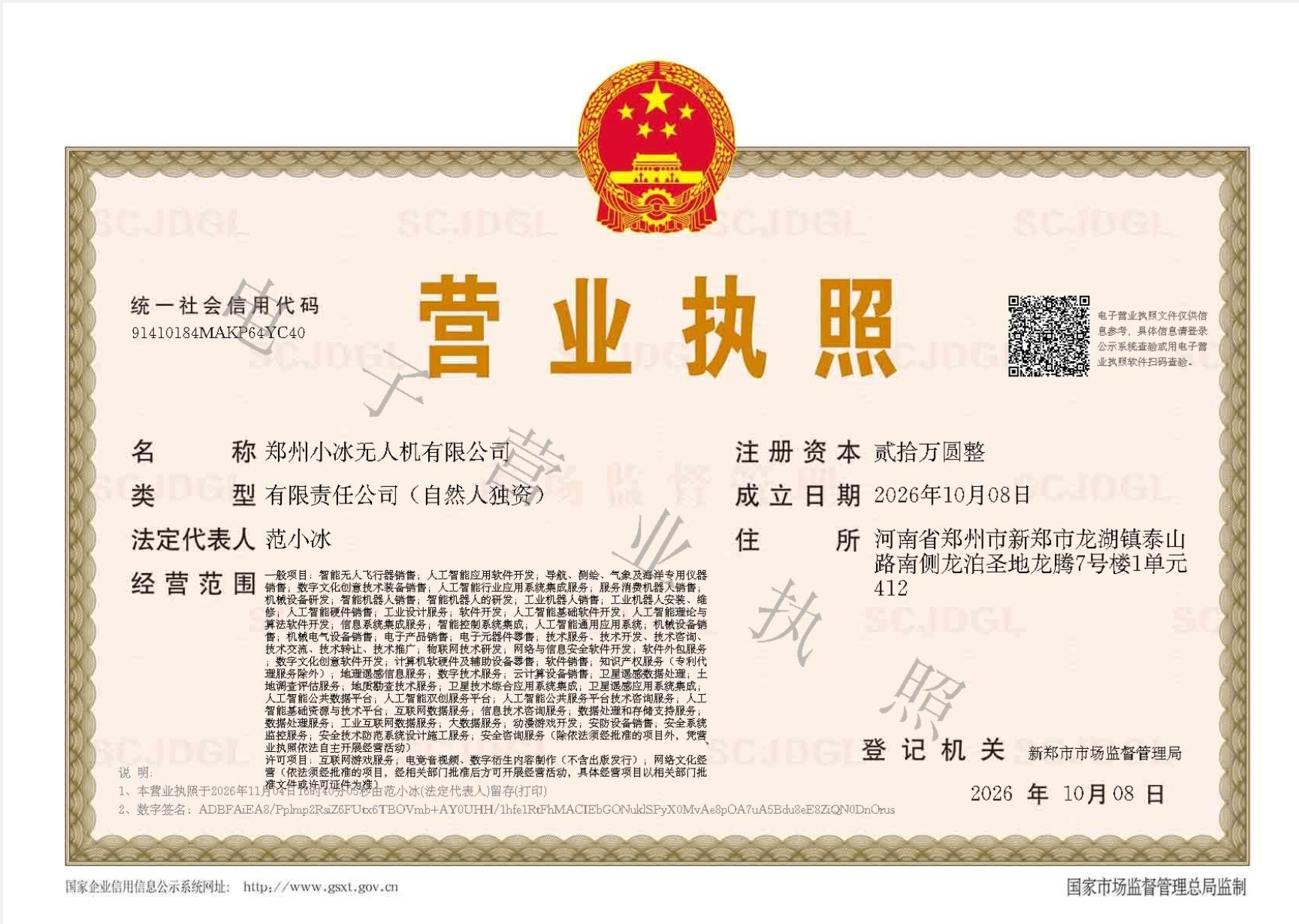 CHINESE BUSINESS LICENCE VIEW EVIDENCE ↗
I do not expect a company registration to prove what I can build. The work ahead will have to prove that. This is simply the first formal step.
Explore my projects ↗