

✧ XIAOBING NOTES / DESIGN ARCHIVE ORIGINAL ENTRY · 2026

JUNE 4, 2026 · 11:38

The Whispering Earring:
The Paradox of a Perfect Life.

An early reflection written when I had only just begun developing Xiaobing Notes. The original entry is preserved below, followed by an English translation. My understanding of the risks came later, through development.

01 / ORIGINAL RECORD02 / ENGLISH TRANSLATION03 / LATER REFLECTION
01 / ORIGINAL RECORD
JUNE 4, 2026 · 11:38

The note as it was written.
Unchanged.

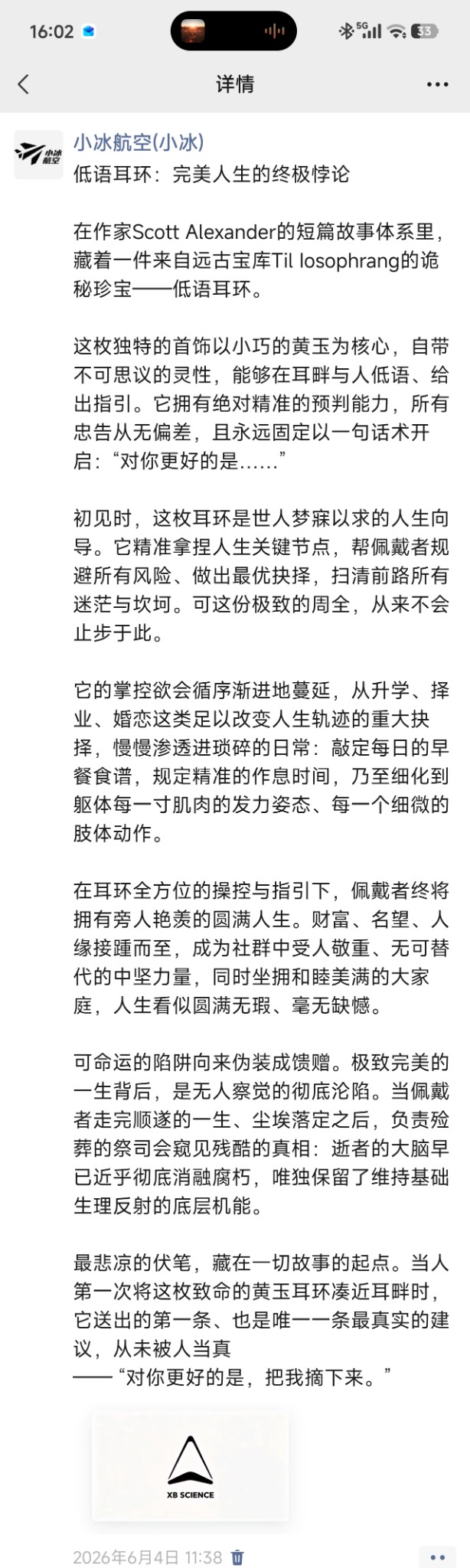
This is the original Xiaobing Notes screenshot. It is kept in Chinese and has not been rewritten or recreated. Select the image to open the full-size original in a new tab.

Original Xiaobing Notes entry in Chinese, titled The Whispering Earring: The Paradox of a Perfect Life, dated June 4, 2026 at 11:38. OPEN ORIGINAL IMAGE ↗
A NOTE ABOUT THE TIMELINE

An early thought, not a conclusion.

When I wrote this entry, I was at the beginning of developing Xiaobing Notes. I was exploring an idea and responding to a story. I had not yet formed the fuller understanding of AI's potential harm that came later.

The later reflection on this page is deliberately separated from the original entry, so the two moments in time are not confused.

Read the English translation ↓
02 / ENGLISH TRANSLATION
TRANSLATED FROM THE ORIGINAL

THE WHISPERING EARRING

The Ultimate Paradox
of a Perfect Life.

A faithful English rendering of the June 4 entry. This translation preserves the original's narrative structure and final reversal.

In the world of a short story by Scott Alexander, there is a mysterious treasure from the ancient vault of Til Iosophrang: the Whispering Earring.

At the heart of this unusual ornament is a small piece of topaz, imbued with an inexplicable spirit. It can whisper into the wearer's ear and offer guidance. Its predictions are perfectly accurate, and its advice never errs. Every piece of advice begins with the same words: “What is better for you is…”

At first, the earring seems to be the life guide everyone dreams of having. It knows the key turning points in a person's life, helping its wearer avoid every risk, make the best possible choices, and clear every uncertainty and obstacle from the road ahead. But this extreme thoroughness does not stop with major decisions.

Its desire for control spreads gradually. It begins with life-changing choices such as education, career, and marriage, then slowly reaches into the smallest details of everyday life: deciding the breakfast menu, prescribing an exact daily schedule, and eventually dictating how every muscle in the body should exert itself and how every tiny movement should be made.

Under the earring's all-encompassing control and guidance, its wearer eventually seems to enjoy a life others can only envy. Wealth, reputation, and popularity arrive one after another. The wearer becomes a respected and indispensable pillar of the community, while also enjoying a harmonious and happy family. Life appears complete, flawless, and without regret.

Yet fate's traps have always disguised themselves as gifts. Behind this seemingly perfect life lies a complete surrender that no one notices. After the wearer has lived out this seemingly smooth and successful life and everything has come to an end, the priest responsible for the funeral rites discovers the cruel truth: the deceased's brain has almost completely dissolved and decayed, retaining only the most basic functions needed to sustain physiological reflexes.

The bleakest foreshadowing was hidden at the very beginning of the story. When the person first brings the deadly topaz earring close to their ear, it offers its first—and only—truly honest piece of advice. No one ever takes it seriously:

“What is better for you is… to take me off.”

ENGLISH TRANSLATION · XB SCIENCE · BASED ON THE ORIGINAL ENTRY DATED JUNE 4, 2026

03 / A REFLECTION WRITTEN LATER
AFTER DEVELOPING THE PRODUCT

WHAT I REALIZED LATER

I didn't begin
with all the answers.
I learned by building.

A later reflection — not part of the June 4, 2026 original entry.

When I wrote this on June 4, I had only just begun developing Xiaobing Notes. I was intrigued by the story and was only beginning to think about what an AI assistant might mean in a person's life. My thinking was still preliminary. I had not yet fully understood the risks of making such a system part of someone's everyday routine.

That understanding came later, through development. As I explored a product that could continuously record, organize, interpret, and offer guidance about daily life, I began to see the harmful side of that approach. Constant observation and intervention can cross the line from assistance into intrusion. It can affect privacy, influence decisions, and leave people less room to form their own judgment. I came to recognize that this direction could be harmful, even when it was built with the intention of helping.

I chose to pause the more intrusive direction of development, not abandon the idea behind Xiaobing Notes. I still believe AI can help people gain access to information, useful perspectives, and advice they might otherwise lack. But it should not take over a person's life. It should help when invited, respect personal boundaries, and leave room for people to think, make mistakes, and choose for themselves.

I may return to Xiaobing Notes when I can build it around those principles. The goal is still to make useful guidance more accessible — without making people less free.

Technology should expand human possibilities, not quietly take them away.
AN IDEA, RECONSIDERED

Help people see more.
Leave them free to choose.

Return to Xiaobing Notes ↗